<100W Quantum Board LED Driver quantum board 100W,100W quantum board DRIVER, custom led grow light led 100 watt grow light ShenZhen Fahold Electronic Limited , https://www.leddriversupply.com
**Home Theater Network HDAV.com.cn**
Is there any real significance to speaker cables? Those who talk about them are either truly knowledgeable or just spending money unnecessarily. Who is the wizard, and who is the Muggle? It's all the same in the end.
What exactly is the electronic component of a speaker cable? Is it just a wire, a copper block, an impedance-matching transmission line, a capacitor, an inductor, or a resistor?
I'm studying electronics, but my music knowledge is limited. I pretend to understand music, opera, symphony, piano performances, tenors, and sopranos. In reality, I’m just playing with sound settings, appreciating the design, and looking at the circuitry. When I was young, I thought I could participate in high-level audio discussions.
It’s important to know whether the thickness and material of a speaker cable affect sound quality. First, we need to understand what a speaker is, what a speaker cable is, and what a loudspeaker is, as well as the concept of damping coefficient.
**The Effect of Speaker Cables on Sound Quality**
1. There are real measurable methods with numerical data.
2. The effects are real, but no instrument has yet been developed to measure them accurately.
3. It’s about the experience of a golden ear—believed but not provable.
4. High-quality materials make it valuable for collection.
5. It’s just a trick to make money.
I’ve personally experienced the second point. More than 30 years ago, to capture the African market, we designed a circuit called "soft clip," which increased power density by 50% without exceeding distortion limits. At that time, both Muggles and top distortion analyzers couldn’t detect the extra distortion in the music.
But then, a golden ear insisted he could hear it, and others confirmed it. As a result, IHD added a new test called "transient distortion value" to advanced sound testing.
In the era before microcomputers, measuring "transient distortion value" required a million-dollar instrument. Even today, instruments capable of measuring this are expensive.
**What is a Speaker?**
When I first learned electronics, I asked my teacher why the impedance of a horn was 8 ohms, but only 0.1 ohms when tested. The Air Force School teacher didn’t say anything for a long time.
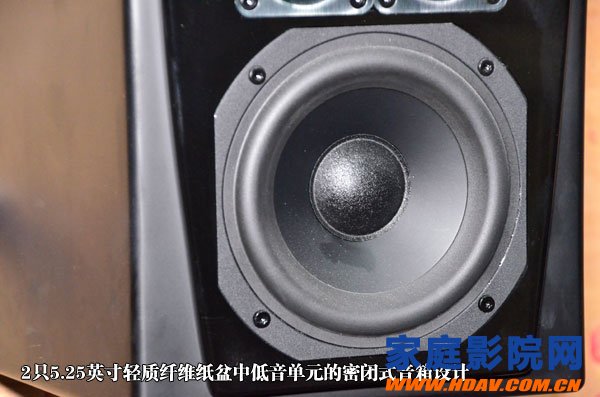
From factory information, I learned that the 8 ohms were measured using a 1000 Hz AC sine wave. For the speaker unit or standard speaker, there's no air cushion, no sound-absorbing cotton, and no details on how far the speaker is from the wall or how the measurement conditions are set. These are industry secrets, rarely shared.
General textbooks casually state it's the AC inductance of the coil at 1000 Hz. But that’s wrong!
In fact, the impedance measurement varies greatly depending on the size of the speaker. If you press the paper cone, the impedance becomes even more chaotic. Therefore, the 8 ohm of the horn can't simply be the inductance of the coil at 1 kHz. If it's not pure inductance, what is it?
Just like a dipole antenna uses a three-meter meter, the resistance is infinite, but RF experts say its radiation impedance is 72 ohms. Similarly, the 8 ohm of the horn can also be considered a pure resistance, not just the voice coil.
Z = R + XL = 8 ohms
XL = ωL = 2πfL
= 2 × 3.14 × 1000 × ? mH = 8 ohms
Actually, the resistance of the speaker as it radiates into the air is the radiation impedance of the paper cone.
A speaker handling a 1:1000 bandwidth from 20Hz to 20KHz is very challenging. It is divided into three speakers:
- Bass: 20–200Hz
- Midrange: 200–2000Hz
- Treble: 2000–20000Hz
Each speaker must handle a 1:10 bandwidth range. Compared to typical radio frequency waveguides that handle 1:2, at most 1:3, speaker operation is extremely difficult.
Since the voice coil is a coil, many electronics experts naturally assume its impedance is 8 ohms from the inductance Z = XL = 2πfL. However, the measured impedance of the horn at different frequencies reveals that the impedance curve isn't exactly like an inductor—it doesn't vary linearly with frequency. At very low frequencies, such as 50Hz, it suddenly increases to tens of ohms, acting as capacitive reactance, which contradicts the inductance theory.
Speakers are affected by the paper cone, speaker, air pressure, and humidity. In other words, 8 ohms is the "radiation impedance" at 1kHz, not just the inductance of the coil.
**Amplifier Damping Coefficient**
The final output mechanism of an amplifier is like a variable voltage battery. The current is controlled by the transistor, and power is output through the speaker cable, causing current to flow in the speaker's voice coil, generating a magnetic field. This field interacts with the magnet, pushing the cone and vibrating the air to produce sound. Additionally, the final stage transistor must provide damping to absorb the power generated by the speaker's voice coil; otherwise, the cone will vibrate uncontrollably. This control ability is called damping.
Because the speaker cone's voice coil has mass and elasticity, and the air inside the speaker has pressure, once the force stops, the cone wants to bounce back. At this point, the speaker's voice coil passes through the magnet's magnetic field. According to Faraday's Law, the coil generates electricity like a generator, and this power must be absorbed and controlled by the amplifier's output impedance. At this point, the final transistor must turn on to guide the current and dissipate it as heat. It's like a car's brake, preventing the car from sliding down a hill.
Therefore, the principle of damping is like someone pushing a cart on a bridge. When the bridge is down, they pull the car to prevent it from crashing. Physicists call this potential energy.
It's also like a car hitting a pothole, where the spring causes the car body to shake up and down more than 10 times before stopping. But if the oil damper absorbs the energy, it stops after one or two shakes. This phenomenon is expressed using differential equations by physicists.
Essentially, damping is how much low-resistance path the final transistor can provide, allowing the counter-electromotive force of the speaker to be absorbed.
Thus, the damping coefficient is defined as the ratio of the speaker's impedance to the amplifier's output impedance.
For example, if the speaker's impedance is 8 ohms, and the amplifier's output impedance is 0.04 ohms, the damping coefficient is 200 (8 / 0.04 = 200), meaning 0.04 ohms has strong control over the speaker cone's position.
**General Amplifier Specifications**
An amplifier with 0.01% distortion and a damping coefficient of 200 is a basic feature of advanced transistor amplifiers. Vacuum tube amplifiers typically have 5% distortion and a damping coefficient of only 10, which is poor, but their even harmonic distortion sounds gentle and pleasing, so no one dares to say their damping is bad. It's like no one dares to say the king has no clothes.
Over billions of years, evolution has shown that rich even harmonics form a sawtooth wave, representing harmony, safety, food, and deliciousness. Rich odd harmonics form a square wave, representing sudden collisions, abrupt stops, and sharp turns—like waves hitting a reef, signaling danger or a predator approaching. Humans find even harmonic distortion comfortable, and listening to music is about comfort, right?
Harley motorcycle ads claimed the exhaust pipe was tuned to create sweetness, specifically 2nd, 4th, 6th, and 8th harmonic distortions. Although this sacrifices horsepower, the Muggle doesn't feel it. Racing experts know, but they're considerate because the ear is more important. Speed is known only to the driver, but the engine sound is heard by neighbors and passersby. It's like buying a million-dollar system—if you don't find a friend, you'll always miss something. Just like playing golf, the long shot isn't important; good putting wins.
Interestingly, when the exhaust produces the largest second harmonic, it's usually the best torque point. Damping is like a car's driving force. The law requires brakes to be ten times the engine's power. The same applies to speakers, with a damping of at least 10, but most people only use it when it's a sacred number, counting money, and wondering why high damping is needed.
People who understand "damping" are qualified to discuss speaker cables; otherwise, everything is just talk, slap, and adjectives.
Golden ears describe clarity, brightness, fullness, warmth, and richness. I can't hear it. What I want is a physical quantity that can be measured.
**Speaker Cable**
The DC resistance of the speaker cable should ideally be zero to avoid damaging the damping coefficient. If the speaker cable has 0.1 ohm resistance, and the amplifier's output impedance is 0.04 ohms, the effective output impedance seen by the speaker becomes 0.14 ohms, reducing the damping coefficient to 57. A good amplifier with a damping coefficient of 200 drops to 57.
0.1 + 0.04 = 1.04 ohms
8 ohms / 1.04 ohms = 57
So, the idea that thicker copper wires are better is mostly correct, but if the DC resistance is already 0.0001 ohms, the effect is minimal. At that point, the total resistance is:
0.04 + 0.001 = 0.0401 ohms
Damping = 8 / 0.0401 ≈ 199.5
Thus, speaker cables thicker than AWG 12 for distances under 3 meters become meaningless. Using thicker wires is just a waste of copper and adds weight.
**Resistance**
What is the DC resistance of a general speaker cable? Check electrical data.
- 5.5 mm² wire: ~0.003 ohms/meter
- 8 mm² wire: ~0.002 ohms/meter
- 14 mm² wire: ~0.0006 ohms/meter
Three meters of speaker cable (round trip) equals 6 meters.
- 5.5 mm²: ~0.018 ohms
- 8 mm²: ~0.012 ohms
- 14 mm²: ~0.0036 ohms
**Speaker Cable + Amplifier Impedance**
- 5.5 mm²: 0.04 + 0.018 = 0.058 ohms
- 8 mm²: 0.04 + 0.012 = 0.052 ohms
- 14 mm²: 0.04 + 0.0036 = 0.0436 ohms
**Damping Coefficient**
- 5.5 mm²: 8 / 0.058 ≈ 137
- 8 mm²: 8 / 0.052 ≈ 153
- 14 mm²: 8 / 0.0436 ≈ 183
At first glance, using a 14 mm² speaker cable seems better, but in reality, modern low-efficiency speakers require a damping coefficient of 10, which is sufficient. The rest is just marketing hype. Otherwise, how would vacuum tube amplifiers work with only 5–10 damping?
**Inductance and Capacitance**
The inductance and capacitance of the speaker cable:
- Inductor blocks high frequencies
- Capacitor short-circuits high frequencies
A 3-meter speaker cable has ~100 µH inductance and ~300 pF capacitance. These values are negligible at 20–1000 Hz, but become significant at 10–50 kHz. It's not about damping, but about phase shift affecting spatial perception.
**How to Reduce Inductance**
To reduce inductive interference, the speaker cable should be as thick as possible. Thickening is not about increasing the copper cross-section. Simply separating the original copper wires, loosening them, and adding insulation support between strands reduces inductance. Multiple strands are not to prevent RF skin current, but to lower inductance. Why does loosening the same number of wires reduce resistance? Ask your electromagnetism professor. After differential equation analysis, the answer is clear. If you believe in the master, don’t waste time understanding it.
If you don’t want to be cheated into buying an expensive speaker cable, you can make one for 1/100 the price. The method is simple, but I learned it through tuition. Don’t use it to deceive others.
**DIY Super Speaker Cable**
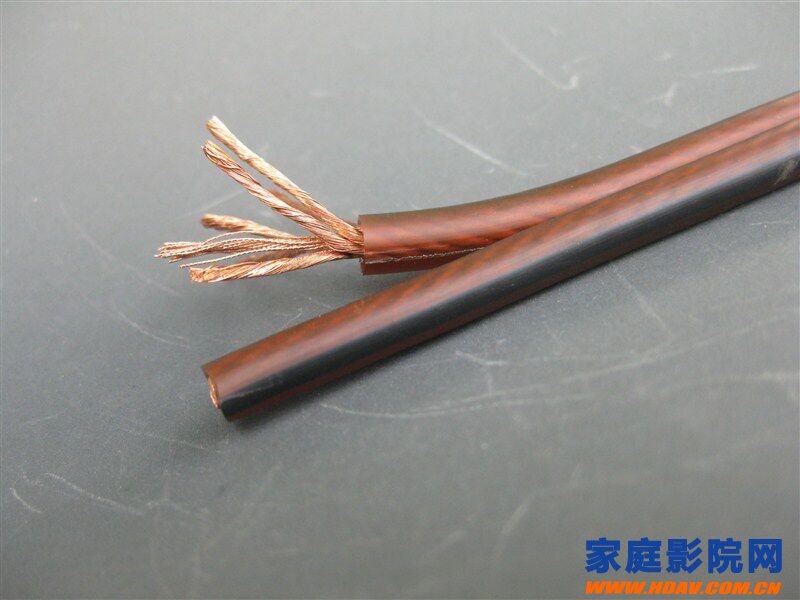
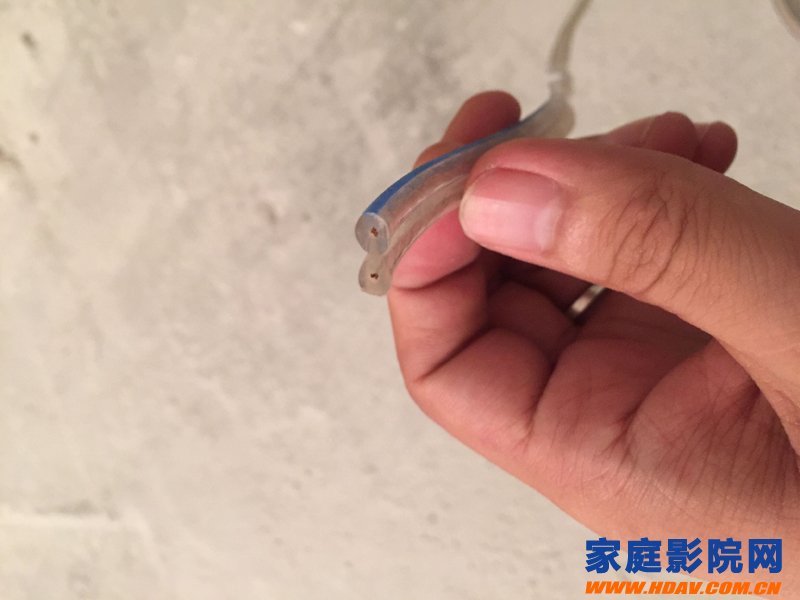
Go to Guanghua Mall and buy a cheap, scam-type speaker cable—thin copper wires hidden behind transparent outer skin. Tie 7 pieces of cotton tape every 20 cm to make it 3 times thicker. The inductance of the speaker cable will drop significantly below 10 µH. Resistance will also decrease by 7 times, achieving two goals at once. If you’re not addicted, use 50 bundles to ensure high-frequency clarity up to 99 kHz. Even conversations will be audible.
However, there is a loss. The capacitance between the speaker wires will increase several times.
**Parasitic Capacitance Between Speaker Wires**
When two metals are close, there is a capacitor. Thicker wires mean higher capacitance, leading to phase shifts. A common parallel speaker cable has ~100 pF capacitance for 3 meters. To reduce it, simply cut the cable and open it with chopsticks every 20 cm. The capacitance will drop below 1 pF.
So, if you see a 10 million yuan audio system in the future, using a very advanced speaker cable that looks thin and not fat, but the two lines are close together, ask the seller: What is the DC resistance, inductance, and capacitance per meter? If the seller can’t give numbers and only says the sound is full, solid, clear, and transparent, smile and buy gold-plated connectors. Then slowly walk away, thinking about what I said on the road, and remember what he said. Bring all the children home safely. Don’t let any country lose its way.
**Transmission Line Characteristic Impedance**
In theory, the speaker cable is like an RF antenna feeder. The characteristic impedance should match the speaker’s impedance to avoid reflected waves.
The problem is that the speaker differs from an antenna, having no fixed impedance. For example:
- **Tweeter**: 8 ohms at 1kHz, 15 ohms at 2kHz, 30 ohms at 4kHz, 60 ohms at 8kHz, 120 ohms at 16kHz
- **Woofer**: 8 ohms at 1kHz, 500 ohms at 4kHz, 30 ohms at 50Hz, 10 ohms at 20kHz
So, the speaker cable is designed to be 30 ohms at 50Hz, 8 ohms at 1kHz, or 60 ohms at 8kHz. But this is incorrect.
As you can see, the speaker cable cannot be discussed in terms of characteristic impedance like an RF transmission line.
Thus, the speaker cable is not a "characteristic impedance transmission line," but merely an extension of the conductor. The resistance, inductance, and capacitance of the conductor should be as small as possible. Impedance matching is impossible.
**Hearing and Financial Investigation**
Age | Hearing Range | Budget
---|---|---
5 | 23kHz | 300 yuan
15 | 20kHz | 1000 yuan
25 | 18kHz | 10,000 yuan
35 | 15kHz | 100,000 yuan
45 | 13kHz | 300,000 yuan
55 | 10kHz | 500,000 yuan
65 | 8kHz | 1 million yuan
75 | 7kHz | 5 million yuan
Akai
2016-11-18
2017-11-18 Minor Revision
2018-01-08 Greatly Rewritten, Adjusted Example Numbers for Readability
----------------------------
This essay is not based on chaos.
The above text is convenient for writing, and the numbers are all captured by memory. They may not be accurate. Please check yourself when reviewing official sources.
For more fresh and fun home theater information, please follow **Home Theater Network** at [http://](http://) (WeChat: cnhifi), the most influential home theater audio player interactive media website in the country.
September 24, 2025